
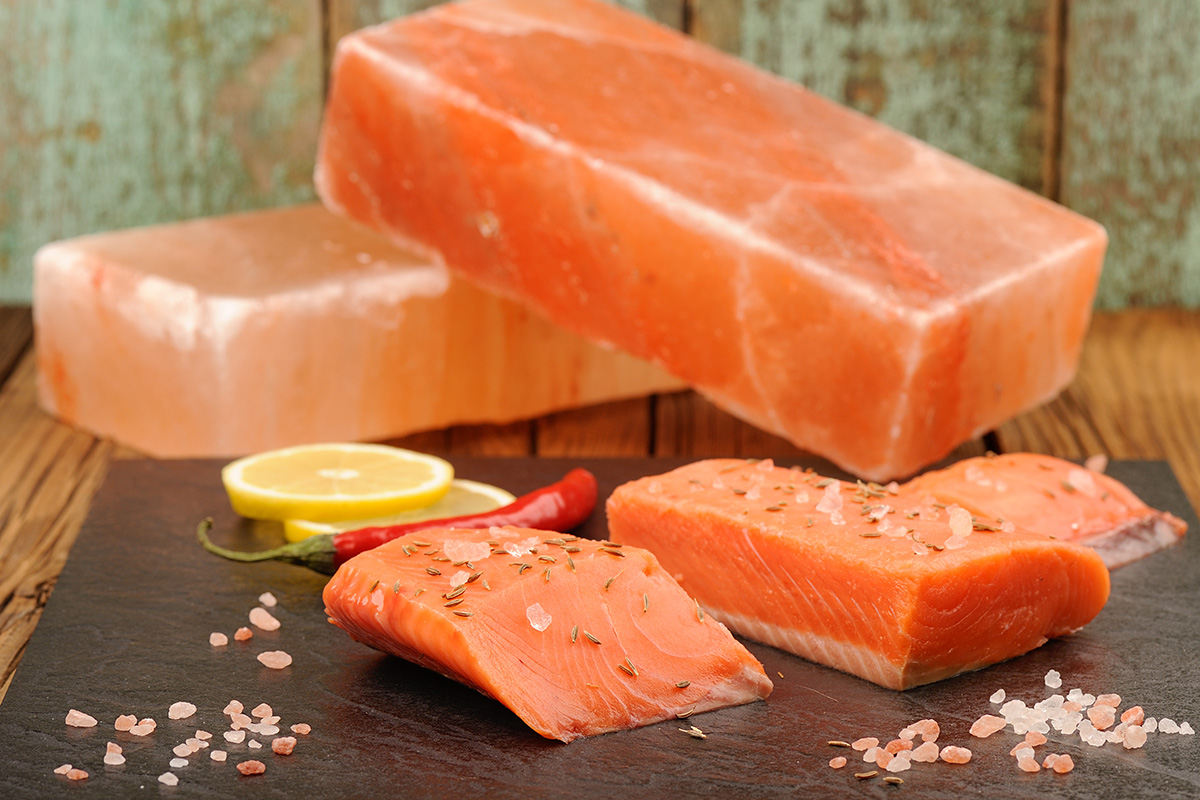
Who has ever thought of cooking or serving food in anything other than a pan, pot, bowl or some kind of board or plate?
Well it turns out we’ve lived a sheltered existence.
Those of you who follow current trends, may have seen these beautiful looking pink rectangular salt blocks popping up everywhere. They have secured the name of Himalayan salt blocks, slabs or plates essentially because that is exactly what they are. These beautifully crafted blocks originate in Pakistan from the salt rock that is extracted from the so-called Himalayan salt mines.
The structure of a Salt Plate
Himalayan salt is otherwise known as a rock salt, or as a form of salt called halite.
This type of salt is formed of isometric crystals which take the shape of a cube. Because of this formation, the cubes sit very closely together and thus reduce the amount of porosity in the salt rock. This proximity of crystals, allows the salt block to effectively distribute and hold any heat (or cold) for a long period of time. Salt has a melting point of approx. 800 DegC, so you can see it can handle a tremendous amount of heat before it undergoes some form of structural change, making it a stable heat source at typical cooking temperatures usually from 100 – 300 DegC.
How to prepare and cook on your salt plate
Initially it may be seem a little unique pulling out your salt plate rather than some form of coated pan or cast iron skillet, but don’t fear, it really is simple.
First up you must know that this new ‘pan’ is not as hardy as your cast iron skillet – so treat it with more respect. Be gentle with the way you handle it and move it between heat source, kitchen table, serving and washing areas.
Know also that as you use your plate for the first few times, it will develop various cracks or fissures and the colour may drain to a whiter complexion. This is normal and still renders the plate functional. The key to a long and rewarding relationship with your salt block, is to take things slow.
Initial preparation (tempering) – for use as a cooking plate
Tempering your salt block is akin to warming up before exercise. You will need to allow the salt plate to adapt itself to the process of heating up and cooling down and allowing the crystal formations to expand and contract without destroying the structure of the plate. Ultimately this will create a stronger plate and more efficient cooking surface.
The process is simple but takes time and can be done in your oven as follows:
- Turn oven onto lowest setting. This typically is around 70-90 DegC
- Sit your plate onto the lowest rack
- Now let the plate sit there for 30 minutes with oven door semi closed.
- You will then need to turn the heat up in increments of 20DegC per each half hour.
- Once the oven has reached a temp of 260DegC, then turn it off and leave the salt plate inside, allowing it to cool down with the oven, to room temperature.
- Do not be alarmed if you hear popping like sounds, as this is just the salt crystals adjusting themselves and creating fissures, which is quite normal.
- Your salt plate is now prepped and ready to deliver a feast of scrumptious meals.
Initial preparation (tempering) – for use as a serving plate
There is no need to prepare your salt serving plates, other than to either pop them into the freezer or fridge for up to an hour prior to serving your cold foods (sushi, dessert, fruits, etc) on them.
Now you are ready to bring out your culinary skills. Have fun!
